Chinese Proverb

"Tell me and I'll forget. Show me and I may remember. Involve me and I'll understand." - Chinese Proverb.
Showing posts with label Informative. Show all posts

Saturday, November 12, 2011

Why in the world do cello pieces have such weird obscure titles?

The other day while I was driving to work listening to one of Bach's cello suites, and I glanced down to look at my player to see which piece was being played. Unfortunately, only the first portion of the title was displayed (not helpful at all), and I thought, "Why in the world do pieces have such weird obscure titles, and why can't this darn player show me the entire title?!" So frustrating!

I had plugged in my iphone to listen to my music, so the display wasn't scrolling through the entire title. I'm sure there's a way to change the setting to scroll through, but my un-savvy tech self hasn't set that up yet, which I'm sure I'll mess up somehow...

Coincidentally, a few weeks later in my Music Appreciation class we went over why classical compositions had such "weird" titles. It was just so freakin cool and fun to learn about it I thought I'd post some of the information. The textbook we are using is Perspectives on Music by David C. Meyer. I'm not a music major, I'm just taking this class to fulfill my Language & Arts requirement and thought it would be a fun easy course. So far, its been very fun and informative, but surprisingly a LOT of work!


Narrative Titles versus Generic Titles

A narrative title (a.k.a. Program Music) is used for pieces that are connected to a story. The title prepares the listener what to expect and if a story will unfold, e.g. The Swan. 
The example in the textbook used Vivaldi's The Four Season, which represents one of the earliest example of program music. He published a set of four concertos around 1725 with one concerto for each season. Ahead of his time, he also provided a sonnet to accompany each of the concertos. The sonnet was meant to be read while listening to the music and he even placed them in the musician's parts to help with musical interpretation! Too bad a lot more composers didn't do this, I think it opens up a lot more doors for interpretations and provides a clearer picture of what the composer was trying to accomplish.

Vivaldi: The Four Seasons, Spring I: Op 8/1, RV 269, "Spring" - I. Allegro


Spring has arrived, and festively
The birds greet it with cheerful song
And the brooks, caressed by soft breezes,
Murmur sweetly as they flo.

They sky is covered with a black mantle, 
Lightening and thunder announce a storm.
When the storm dies away to silence, the birds
Return with their melodious songs.

After learning about this, every time I hear this piece it totally makes me smile! Imagining the chirping birds and impending thunderstorms with the birds flapping around seeking shelter. I always imagine little baby birds poking their heads out after the storm to check to see if the coast is clear - it's just SO CUTE!!

_______________________________________


GENERIC TITLES

A generic title informs the listener the genre of the music and provides the composition's information. So the example of the Bach piece, where my in-dash player was only showing "6 Suites Son..." instead of showing the full title:

6 Suites Sonatas for cello BWV 1007-12: Suite No 1. in G Major, BWV 1007 Prelude 

The breakdown of the title:
  • Form: Tells us what form the composition will follow. In this case it's in Sonata Form so it will have an Exposition, Development, Recapitulation and Coda. Other forms include concerto, symphony, etc. Also, it tells us there are 6 movements in this composition
  • Catalog System: Titles using the number from the catalog of the complete works instead of an opus number means that composer didn't publish a lot of works during their lifetimes. Many composers have between 100 to 200 opus numbers, but some have more than a thousand! For Bach, BWV stands for Bach-Werke-Verzeichnis' catalog system which is then followed by the catalog number. Mozart's work are assembled by Ludwig Kochel and is appended in the title as "K," for Schubert the catalog is by Otto Erich Deutsch which is listed as "D" 
  • Musical Key: provides the key the piece will be played
  • Movement/Tempo: Indicates which movement out of the six suites will be played: Prelude, Allemande, Courante, Sarabande, Galanteries & Gigue. Typically it will provide the movement number which is usually given in Roman numerals and the tempo marking of the movement. If all of the movements are being performed in a concert, than the movement is usually listed beneath the main title 


Other Examples:
Mozart, Symphony No. 40 in G Minor, K. 550, I, Molto Allegro
Handel, Concerto Grosso in G Major, Op. 3 No. 3

  • Opus Number: Opus means "work," abbreviated "Op." This number is assigned by the composer to the pieces as their work gets published. Therefore, the first work is always Op. 1, and then Op. 2 and so on. This tell us whether the work was written earlier in the composer's career
  • Composition Number: The composition number is included within the opus number. In Baroque and Classical periods, publishers sometimes bundled together works in groups of six or twelve. So for Handel's Op. 3 Concertos, you have to indicate which concerto you are referring to in the set of six, in the example it's number three out of the six
  • Type of Piece: the number (usually in the order the composition is written) regarding that kind of piece, e.g. Symphony, Concerto, etc.  
  • Composer's Name: provides composer's last name

Anyway, I thought it was fun learning about that, so I thought I'd share!

Monday, October 3, 2011

Cello Review, Part 2: Jonathan Li cello

The first review will be on the Jonathan Li cello.

The contenders were:


2011 Eastman Jonathan Li 503 (left with the lightest color)
2011 Calin Wultur Student (middle)
2010 Eastman Pietro Lombardi 502 (right in case)

A quick note: ALL cellos are different, so if you're looking at the same maker and model, the cello will most certainly have different characteristics, so none of this applies except to these specific cellos.


2011 Eastman Jonathan Li, Model 503, Stradivarius, Beijing, China


Evaluation: My favorite and will be my primary cello
  • Description: the Jonathan Li cello is Eastman's top cello in their 500 series line, which is described as:
    • A cello crafted from the most select, stunning flamed Maple back with a straight medium-grain spruce top. A refined, golden colored oil varnish enhances the tonal quality of this cello. Each cello is meticulously calibrated for optimum sound production.
    • This cello was made from one of Eastman's small workshops in Beijing where production isn't the primary incentive and only a few higher skilled makers in their shop get to produce the 500 series (Jean-Pierre Lupot 501, Pietro Lombardi 502 and the Jonathan Li 503 cellos). These celli are not mass produced and are only distributed to small violin shops. 
  • The 500 series is not listed on Eastman Strings website either...wish they would post information on these celli! Come on - we consumers want to know!
  • Some Eastman Info:
    • Eastman has quality, properly cured woods and the largest supply of tonewoods from all over the world and takes proper care and time to air dry their wood for a minimum of 5 years in a controlled environment, i.e. they store their wood inside large buildings to protect them from the elements. 
    • Eastman cellos are also backed by one of the best warranties in the industry, which covers any defects in material and construction for the lifetime of the product. 
    • Why so many Chinese made instruments, including these Eastman cellos? Chinese makers are consistently winning Gold at Violin Society of America (VSA) shows as well as other maker's competitions with their instruments. These instruments are no longer considered bottom of the market, nor cheap. Many Chinese luthiers are highly respected and are making professional level cellos costing as much as the best American instruments. These Eastman instruments are fully handmade without the use of power tools, whereas German instruments costing under $10,000 are all machine carved and then, on better instruments, hand finished.

This NOT an endorsement for Eastman Strings, although I did just purchase two Eastman cellos... ;). And certainly NOT a recommendation to go out and buy a Chinese cello from eBay!!  Please don't! This is just my observations, so take this all with a grain of salt and don't buy anything because what I posted...just saying...just in case...


Sound Quality:
  • The sound of this cello is very smooth and warm and sounds great under my ear. However, I haven't shown this cello to my teacher yet, so I don't know if it sounds good to other people or on a recording. I don't have an audio clip of it, but I'll post one as soon as I get my cello back (hopefully by the end of next week). 
    • Although I haven't shown my teacher or recorded it, this cello sounds absolutely beautiful under my ear and is very comfortable, and responsive to boot! :)
  • These three cellos were like The Story of Goldilocks and the Three Bears! The first cello (Pietro Lombardi) didn't have enough volume and wasn't as responsive, the second cello (Calin Wultur) was too responsive and had too much volume, and the third (Jonathan Li) was just right! I received those cellos in that order too, go figure! :).
    • The Li's volume is in between the Calin Wultur cello and the Pietro Lombardi cello, with the Lombardi being the quietest. The Li is not as loud as the Calin, but I don't need a cello with lots of volume since I'm not doing solos, recitals or playing in an orchestra yet. Not to say that the Li cello is a quiet cello -the volume is fairly close to the Wultur's volume and I'm sure the Li's volume will increase as soon as the varnish cures completely and the cello acclimates and settles into its new home. It also has a thicker, richer type of volume... if that makes sense...

  • The audios for Jonathan Li with different strings and bows are posted below. The first half of each recording uses a cheap carbon fiber bow and the second half of the recording uses a pernambuco Paesold bow
    • Evah A and Permanents D, G, C:  
    • Jargar Fortes on A&D and Permanents on G&C:


Response, Comfort & Playability:
  • The Li's response is in between the Wultur and Lombardi celli and is perfect for me. The Wultur is waaaay too forgiving, i.e. when I play the Wultur first I can't get a good sound if I play other cellos afterwards because I've gotten sloppy with my bowing playing the Wultur. Although I'm sure the Wultur would be great for a cellist who has their technique under control and wants an easy response - not me though, my technique needs lots of work! :). Whereas, the Lombardi is more particular in producing a good sound, and won't make a good sound unless I bow correctly. It was a bit frustrating at first playing the Lombardi, but it definitely has helped me improve my bowing and playing any other cello is a piece of cake! The Li cello is in-between both of these - an easier response than the Lombardi, but not overly easy like the Wultur
  • The finger spacing is also just right on the Li cello. The Wultur string length was too long (27 1/8") and was making my hand tense up trying to spread my fingers wide enough, making my hand hurt. It's also the bigger pattern of the three cellos even though they're all Strad models. The Lombardi string length was too small at 26 3/4" which gave my hand too much "wiggle" room and made it harder to get my fingers in the right position moving from one string to another because my hand wasn't stretched enough and would collapse.  The Li at 27" is just right, and my fingers fall perfectly into place naturally and feels great! I didn't think I would notice any difference in string lengths, but I definitely can feel it in my hands! See...just like the story of Goldilocks and the Three Bears!
    • Being a beginner, the string length affects me a lot, but I'm sure I'll get used to it eventually. More experienced cellists probably don't have this issue
    • I've learned that knowing the measurements of my current cello is a good idea so I have an idea whether the cello will feel good and to minimize surprises when ordering online. I liked my rental cellos measurements and discovered that it was actually a 7/8 cello! After testing larger patterns I learned not to look at larger patterned or larger measurement celli because they don't feel as comfortable to me. I'm 5'6 so I'm right between small and large patterns, but I definitely prefer small
      • Example: I tested a 4/4 Montagana pattern and a 4/4 Giovanni Baptist Gabrielli pattern and found that they were too big for me. For the Montagnana it was due to the upper bouts being so large (I like upper bouts below 14") and the Gabrielli pattern is just a large pattern in general. I think a 7/8 Gabrielli pattern would have worked for me, but the local shop I tried it at only had a full size. 
      • However, once I get more experienced and my fingers and hands stretch out from playing the cello for awhile, I think I want to try out a Montagnana or Gofriller pattern because I LOVE how those patterns sound in general! That will be in 5+ years though - I don't want to go through the experience of looking for another cello again! It took me 3-4 months to decide on a cello! It was fun at first, then reality sunk in...

      • Measurements: The Jonathan Li's string length is right in the middle of the two and feels just right! The string length made all the difference in the world to me, even though all the measurements are fairly similar
        • Pietro Lombardi cello (Strad):
          • Length of body: 30"
          • Width of upper bout: 13.375"
          • Width of c-bout: 9.375"
          • Width of lower bout: 17.375"
          • String length 26.75 - too short
        • Wultur Calin cello (Piatti Strad):
          • Length of body: 29.875"
          • Width of upper bout: 13.5"
          • Width of c-bout: 9.25"
          • Width of lower bout: 17.5"
          • String length: 27.125" - too long
        • Jonathan Li cello (Strad):
          • Length of body: 29.875"
          • Width of upper bout: 13.5"
          • Width of c-bout: 9.5"
          • Width of lower bout: 17.5"
          • String length: 27" - just right!! :).
    • No wolf tone on this cello!! Well, a very, very small one, which gets stronger with certain strings, but has disappeared with the current string selection I put on! 


    Maintenance & Health:
    • Adjustment: Having the cello adjusted to the cellist once it's purchased should be part of the buying procedure as the preferred setups are unique to each individual cellist. Some shops will adjust a cello for for free when the cello is purchased. However, since the shop I purchased this cello at is out of state and the difference in climate, I took it to my favorite violin shop instead. The luthier lowered the nut, adjusted the soundpost and did some work on the bridge. 
    • Acclimatization to drier climates: Since this cello was made in 2011 and shipped from a more humid climate to a dry climate, it's having some acclimatization issues.
      • What I've learned: Cellos from China may have wood with a high moisture percentage when assembled there and can have shrinkage issues with coming to drier climates of the US. Often times, shops will hold the cello for a time period in their shop and monitor the cello as it gets acclimated.  There really is no way to prevent shrinkage from happening, especially if the cello is traveling from one state to another, or from one country to another. It's just part of the finicky nature of cellos and the process of a new cello settling.
        • Since Eastman creates these celli in a temperature and humidity controlled environments, the shrinking issues were most likely from the result of the cello traveling from the more humid climate of California to the much drier climate of Colorado. Also, the seasonal change from Summer to Fall could have affected it as well. There is no way to tell for certain what caused the issue unless I was able to watch the cello's production from start to finish.
      • The seams opened up a few days after I got the cello back for the adjustments. The ribs also started to bulge at different sections along the seam and the neck started to curve as well, so I took it back to my luthier who opened the seams and cleaned out some of the stain/varnish that had leaked into the seam closing (which may attributed to the open seam). He then let it sit for a few days to help the cello get acclimated and then reshaped and glued the bulging areas. 
      • Currently the neck/fingerboard is being straightened because the neck and fingerboard was starting to "back bow" which happens in dry climates quite often. It's been two weeks since I dropped off the cello but the wood hasn't straightened yet - I'm having Li cello withdrawals... blah! :(. Anyway, the luthier removed the fingerboard from the neck, which is a glued-together unit, to see if the neck will flatten on its own. However, the longer it was back-bowed, the more difficult it'll be to flatten it out. Therefore, if its been back-bowed for awhile, he'll need to use different techniques to straighten the warping, which will of course cost more. He may also need to re-plane the fingerboard playing surface as it is beginning to develop bumps from shrinkage!
    • I'll be taking the cello to the shop in another 6 months just for a checkup to make sure that it doesn't have any further settling issues. Even with all of these acclimatization "issues" I still believe this is the cello for me!


      Resale value:
      • I'll be holding on to this cello for a very long time! I'm not letting go of this puppy! :). However, the shop provides a generous 100% trade in value for an instrument of a higher price.


      Appearance:

      •  ....oooo...soooo...Pur-Tay! :). High flaming on the back! 
      • What's the deal with flaming anyway? 
        • Historically, highly flamed pieces were reserved for more expensive cellos, so it became a quick indicator of the quality of wood being used. Although this is no longer true today, there are many modern violin makers creating expensive cellos without highly flamed pieces. I just lucked out and came across a cello that had high flaming! :). Also, cheap knockoffs will paint artificial flaming so they can state it has high flaming to increase the price.
        • Instruments should be made with spruce tops and maple ribs and bottoms. 
          • In my opinion, they're really is no need to rent or purchase laminate wood cellos, as I've come across cellos in the same price range using spruce and maple. Even though they're more durable (my first rental cello was laminate wood), its not conducive to sound. In retrospect, for me it was less enjoyable playing on a laminate cello. There really is nothing better than hearing the ringing tones of a cello and then realizing the sound is coming from YOUR cello! Okay, I have to admit that sounded a bit conceited, but its totally true! However, it definitely motivated me to get better sounds out of my cello!
      • I'm not too fond of the lighter varnish, I prefer darker varnish, but its still a very beautiful instrument! I saw this olive/chocolately colored cello that was absolutely beautiful. My least favorite varnish color - the reddish-orange varnish...
      • This came with all of the fittings that I requested on my first cello (Lombardi) with beautiful ebony Pegheads (all my cellos have Pegheds!) and ebony Les Bois d'Harmonie tailpiece which makes this lovely cello that much more beautiful..IMHO.


      I purchased this cello and will be using this as my primary cello.

      Wow, that was a long post... hopefully, my review on the two other cellos aren't so long. Next review: the Pietro Lombardi cello...

        Friday, September 16, 2011

        A quick thought on visiting violin shops

        Before coming across this wonderful shop, I didn’t like spending money on adjustments and couldn't justify this expense, but finding this wonderful shop has completely changed my mind!

        This violin maker David, is a great resource, has a wealth of information that he enjoys sharing, is patient and understanding, and has done wonders for my cello! I know finding a knowledgeable, experienced luthier is difficult and expensive, but I’m telling you its well worth it! I just can’t say enough great things about this shop!

        When I picked up the cello from his shop for an adjustment (he thinned and adjusted the bridge, replaced an ill-fitting soundpost and lowered the nut), he had me play it and then afterward asked me what I thought, which kind of threw me for second… “Huh? I’m supposed to give you feedback? Oops, better play it again and pay attention!”  
        In the past, all I did was drop it off, tell them what I thought was wrong, and then pick it up later to find it sounded better (and in one case – worse!)

        To me it played much easier and was more responsive, but was on the bright side which I tend to the warmer side, and I told him as much. He plays the violin so he likes brighter instruments, but instead of trying to convince me otherwise [which I’ve had another luthier tell me, “brighter is better and that’s what most professionals like” ....but I’m not a professional and my ears aren't that discerning yet. Maybe I’ll change my mind later...], he was very accommodating and moved the soundpost to make it sound darker! Apparently, moving the soundpost even a millimeter (or less) in a certain direction can make the sound brighter, warmer/darker, more brilliant and certain strings louder or quieter! WOW!

        He brought it back to his workbench and allowed me to watch him make the adjustments - more like hover like an annoying gnat! ;).
        We headed back to the sitting room to test it, and again he asked what I thought. This time I was paying attention and was ready! It sounded darker, but less open…  It’s hard to describe - “open” meaning I could tell that the sound carries throughout the room and projects further, whereas a “less open” sound seems to be thicker (almost muffled) and the sound sort of hangs around me like fog, instead of dispersing throughout the room.

        He adjusted it again and this time it sounded more open but still retained the warmth, and it made my A&D string brilliant and my G&C string smooth and rich! It’s totally magical. Yep – MAGICAL!

        With all of my different string combinations, he was able to get it sounding 200x better! Not to say my efforts were a waste of time, I learned a lot about strings and I still needed to find strings that were balanced with the sound that I wanted, but he made my string combination that much more better! He also gave some string recommendations. However, I still want to experiment to find different sounds and to discover the relationship between the string's tension, string's material and cello. I've yet to add bridges to that mix, but that will probably be next year.

        I just can't stop raving about this shop! I’m not here to advertise his shop, which is why I’m not listing the shop's name. Is it bad to keep a good thing a secret? ;).
        Well, I guess if you're local and are curious let me know. Actually if you’re NOT local, I don’t want you going to the shop so he’s too busy to take MY appointments! Just kidding…well, kind off… =p.

        Anyway, find a knowledgeable, experienced luthier that you like and trust (his was the 4th shop I visited), ask them a lot of questions, learn more about your cello and enjoy the experience! I think if more people knew what these wonderful professionals can do for their instrument they’d be visiting more often! And maybe it wouldn’t be as expensive….supply and demand, right? ;).


        Thursday, September 15, 2011

        A trip to my favorite violin shop - Part 1: Bow Maintenance & Rosin Maintenance

        I took a trip to my favorite violin shop a couple of days ago. I LOVE going to this shop - like a kid in a candy store! :).

        This is my third visit and I always end up spending more time than I should! Although David has been really nice about not charging me the full amount for the time spent there because I ask waaay too many questions, but I think he likes explaining things to someone who's really interested. I think a violinmaker's job is totally fascinating! I always learn so much visiting this shop and its really interesting when he shows me different aspects of the cello or shows me the processes of putting his violins together. SO MUCH FUN!! I know, I'm weird... :).

        During my last visit, he explained how they cut the wood to create the front and back plates of the cellos and his trip to Europe to pick out the wood he was going to use to create his violins. I would totally love to sit and watch him put together an instrument!

        I had brought the two cellos I had on trial to the shop and David went into some great detail with the measurements and what those measurements meant. Although I'll try and not go into too much detail because I kind of think that violinmakers want to keep all this information a trade secret or something. Maybe not, but just in case... I don't want to offend him or anything.

        Anyway, I think I'll make this post a two-parter (maybe three) to go over bow maintenance and what to look for in a cello, and maybe cello maintenance. 

        Some great information on cello bows from Finckel's Cello Talks:

        Talk 8: What the Bow Does:

        Talk 12: Bow & String:


        Cello bow hair information:
        • The violinmaker explained to me how a cello bow's hair works, which is hair from a horse's tail. I hope I'm stating all of this correctly - he provided a lot of information and I didn't take notes. I didn't want to bust out with a pen and paper and ask him to repeat everything! ...such a dork.. :).
        • When talking about bows, most people will explain it as barbs sticking up, which is what the rosin attaches to.  However, hair shafts are more like shingles on a roof, see magnification of horsehair below from a microscope:
        • Okay, I have to admit that kind of looks gross to me (it reminds me of insect legs or something!) and I have a weird compulsion to scratch at it.... LOL! :). Anyway, rosin gets trapped between the grooves which allows the bow to grip the cello to create sound. And if you've ever had a brand new bow that has never been rosined, than you know the bow will just skate atop the strings and doesn't make much sound
        • So what happens when I don't clean my bow? ...which I've NEVER cleaned my bow before! Oops!
          • 1) The rosin accumulates and also starts to harden. Hair is made of several layers, and eventually the build up will cause the outer layers of the hair to thicken and harden 

          • 2) The horse hair starts out to be circular, but due to bowing and rosining, over time it starts to flatten and become more oval in shape. Therefore, the rosin has less surface area (crevices) to attach to:
          • 3) This causes most cellists like me to add more rosin to try to get the bow to grab the hair like it once did - which only compounds the effect, i.e. the build-up of rosin gets thicker from application of more rosin and the hair's walls become denser and thicker which also makes the hair less flexible and more prone to break! ...ahhh... that's why I've been getting some breakage!

        Bow Maintenance
        So how do I keep my bow hair as healthy as possible?

        • Normal maintenance: wipe off the excess rosin from the bow, loosen the bow and then put it away 
          • Keep a cloth just for the bow hair and to wipe off the strings; and another cloth to wipe off the body of the cello paying attention to the area around the bridge
        • Once a month clean the bow hair using a toothbrush!
          • What? Yeah, I never heard of this before either! Why didn't someone explain this bow maintenance to me when I first started playing?
            • 1) Take a clean toothbrush and gently run it through the horse hair at an angle
              • A puff of rosin may come from the bow, which is normal. This will help with the responsiveness of the bow
            • 2) Blow on the hair to get the extra rosin dust off
            • 3) Then wipe off the extra rosin from the bow
        • Look at the bow under a light and the hair should be fairly shiny from its reflective surface which will tell you if the bow hair is "healthy"
        • I'll add some pictures later when I clean it next time


        Rosin maintenance:
        Rosin is equally important in producing the sound. I asked him if he had any recommendations for rosins and he just asked what I currently have, so I handed him my Andrea rosin, which apparently is a fairly good, expensive brand. It came with  my first rental cello outfit so I didn't have to purchase it.
        • He looked at it to make sure that it was still good, which it was, but I forgot to ask how he knew that was the case. I'll have to ask him next time I visit the shop
        • I was starting to wear small grooves into the rosin, which I didn't know was a "no-no"

          • Why? Apparently grooves in the rosin create more surface area which allows for more oxidation of the rosin. Since terpene is a major component of resin, it can be modified chemically through oxidation, which is why its important to always seal up (or wrap) rosin when its not being used and why rosin generally doesn't last very long. Rosin is generally recommended to be used within a year
            • The rosin I'm using has a screw on cap which should allow the rosin to be preserved longer. I think David said up to three years
          • David recommended when I rosin my bow I to go across different areas of the rosin to keep it relatively flat to prevent grooves from occurring
          • Also, most cellist use two rosins - one for the warmer seasons and another for the colder seasons
            • The darker rosins are generally for cold and dry climates or seasons while lighter colored rosins are generally for hot, humid climates or seasons. Living in Colorado with its dry, and mostly brisk weather, I should be able to get by using dark rosin only. I'll have to post more info on that later

        Bow parts:
        Always a good idea to know the different parts of the cello bow


        Part 2 should be in about a week or two...scratch that - I'll post it under a blog called Cello Review & Purchase.

          Saturday, June 25, 2011

          My New Cello Project: The 99 Most Essential Cello Masterpieces

          I love all things cello!! :)

          I've been listening to The 99 Most Essential Cello Masterpieces to get familiar with cello pieces since I'm new to listening to cello music and classical music in general. And I thought, "what better way to learn about each piece than to do a little research on each one and post a blog of what I've learned!"

          Yes, I seem to have a lot of time on my hands! :)
          My husband and I both work full time and I'm taking the summer off from school, but he's plugging away on his doctorate thesis - so I've been having some extra time on my hands.

          My goal is to do a little bit of research on each piece by looking into the composer, history, and any other relevant information I may stumble across and post it on a blog. I thought I would post it in this blog, but I already post so many entries that I think that it would "clutter it up."


          Why is it important to understand the history of each piece? 

          In David Finckel's Talk #96: Knowledge he posts: "Musical knowledge certainly encompasses instrumental technique and the music itself, but knowledge of history, cultures, styles, composers' lives and related subjects is just as important, if not in some cases more so."

          In his insightful YouTube video below, he explains the importance of knowing the music being played:


          These talks are AWESOME!! I've watched every single one! A lot of it is still over my head, but I think if I need additional help/resource I'll know which video to watch.

          My new blog project: Cello-Brained: The 99 Most Essential Cello Masterpieces Music Project.

          Wednesday, June 22, 2011

          Learning through Active and Passive Listening

          Below is a repost of a blog from Emily Ann Peterson regarding active and passive listening. - Couldn't have said it better myself!

          ***************************************

          12 Ways to Listen More


          Every Suzuki student should know the difference between Active and Passive listening, and incorporate both into everyday life and practice. And even if you’re not a Suzuki student, you should still know and do both. You should know because listening is a crucial part of being a musician. Listening constantly to music teaches the brain to listen for those sounds in the future.

          I ask all my students to listen to the entire Suzuki CD (of whatever book they’re learning) once each day. Sometimes its like pulling teeth to get this to happen, but when it does, EVERYONE wins. I don’t think students would “hem’n'haw” so much if they knew how much easier life gets when they listen to the songs they’re learning or have learned.

          It happened this week with one of my kiddos. We missed our lesson last week because I was at Teacher Training, so she did a lot of listening. Oh sweet victory! It worked! She came to her lesson yesterday with the next song’s notes learned and her body and soul were ready to “get her learn on!” Mom even noticed a difference!

          So here’s the deal with listening. There’s Active Listening and Passive Listening. It’s important that musicians do both. Both engage different parts of the brain, parts that we need while playing music ourselves. Both assist in a general comprehension of the music to which you’re listening.

          Active Listening

          Active Listening can be thought of as reacting to what you’re hearing. When you’re actively listening to the music, it has your undivided attention. You then do something that demonstrates you are listening and understood.

          Passive Listening

          Passive Listening can be thought of as listening without reacting. Music turned on the background is a good example of this kind of listening. You’re hearing the music, but not necessarily responding to it outright.
          Imagine a 9 year old playing video games in the basement. Mom yells downstairs, “Dinner’s ready. Bring up the laundry when you come up!” A good example of active listening happens when our little gamer friend, yells “Coming!” and adds, “The laundry’s not dry yet!” Proof of passive listening would be if he paused the game and just came up stairs. He might’ve heard his mom say something but comprehension and understanding didn’t occur (or let’s face it, he might just be lazy.)

          Ways to incorporate Active Listening into your own practice routine…

          • Freeze and hold for the entire length of the song. Do this with bow holds, cello posture, extensions, anything that requires a static muscle memory.
          • Turn it up and Dance! This works wonderfully to songs in 3/4 or in 6/8. It allows you to really feel the sway of the rhythm and musical phrases.
          • Watch it happen on paper! Listen to the song while you drag your finger across the page. I have even known some students to mimic the needed weight of the bow on the page with their finger tip.
          • Air-bow in your lap with the bow upside-down (bow hair in the air) and do the bowings during the song.
          • You make me want to La, La! (Sing “La” along with the music.)


          Passive Listening Ideas

          • Turn it on while doing chores.
          • Listen while you write in the bowings. This should probably be done towards the beginning of learning a piece to have its full effect.
          • Have it playing in the background of work or homework. (Make sure this is okay with your cubicle partner or have headphones handy.)
          • Draw or color while listening. Brownie points for drawing me a picture and emailing it to me!
          • Take a bath and have it playing.
          • Listen in the car.
          • Listen while brushing your teeth and getting ready for bed. (This one’s especially good for (pre)Twinklers. Twinkle is the perfect teeth brushing length!)

          ***************************************
          All great and wonderful ideas!!

          What I've also found very helpful is writing in the lyrics to the Suzuki pieces and singing along!
          Most of the lyrics to the Suzuki pieces in Book One can be found on the Amarillo College Suzuki String Program website.


          So far I've only been doing 2 out of the 5 active listening (watching it on paper and singing along) and 4 out of the 5 passive listening activities (while doing chores, in the background at work with ear buds, in the car and getting ready to go to work). Go me!!

          I'll have to see if I can incorporate the rest! :)

          Friday, June 17, 2011

          Take a "Brain-Dump": Why I think blogging about lessons & discoveries is essential to cello learning

          I've learned so much more while blogging, than when I wasn't blogging!
          I think this due to the fact that I've started flushing out all the details after each lesson by trying to blog about every detail we've covered during my lesson.

          This has also made me much more conscientious because I've had to type up my ideas and information, and put it into coherent sentences. Putting my thoughts into words has definitely helped cement ideas and information I've learned during each lesson!

          In the beginning, I wasn't learning and retaining as much information because I wasn't writing down and flushing out the details of each lesson. Now, I'm surprised to see how much we cover during my lessons! Adam once told me that, "there is SO much information out there, so I'll only give you as much as you could handle."
          In the beginning, I was definitely missing a LOT of information, which probably made it look like I couldn't handle much.

          There are a lot of recommendations out there to practice immediately after a lesson, but I think flushing out the details is better than practicing after a lesson. It's what my prior boss used to call a "brain-dump!"
          Yes, I know... a bit of toilet humor...wah, wah, wah.... =p

          I'm not talking about, arriving home from a lesson and then taking a break to eat dinner, watch some television and then start writing down what I've learned. I mean writing down or typing everything I can possibly think of as soon as I get homesystematically from the beginning of the lesson to the end of the lesson. My husband knows not to bother me right after my lesson, as he knows I have to do a "brain-dump" of everything I've learned.

          I think if one waits too long before doing a brain-dump, than they loose some descriptions of feelings or body positions that they felt during the lesson, which is crucial in re-creating the movement during practice time.

          My reasons for flushing out details first - instead of practicing:
          1. It changes my priorities
            • I’ve discovered that if I immediately practice instead of flushing out the details, I practice what I think is important and not necessarily what my teacher was trying to get across. When this happens, I forget (not on purpose) about the rest of the information provided during the lesson because I'm so focused on getting a specific part of my bowing or fingering fixed. Thus, I learn less!
            • I also tended to focus on corrections made during the end of the lesson and forget about the corrections made in the beginning.
            • By making sure I have all the details down first, I can review the lesson as a whole and determine what were the really important pieces of information that I should be practicing.
          2. Origin of epiphanies
            • I think unless I'm consciously aware of the information first, it cannot be utilized.
            • By first flushing out the details, I can remember little tidbits, which can be helpful in the future. Information from the past that I've made conscious effort to think about and write down suddenly make a connection to what I'm working on and it "clicks." If I don't write it down and make a conscious effort to access the information (i.e. blogging about it), than the information cannot be utilized and it is eventually forgotten altogether.
            • I can also access the information again to strengthen what I've learned by re-reading my blogs, which makes the information more accessible and therefore, more easily available for epiphanies to occur!
          3. Learn more efficiently
            1. My blogs are getting longer and longer because I'm taking the time to process the information by thinking about it and blogging about it. When I look through my blog and compare them to my previous notes (prior to implementing the brain-dump), I'm certain I'm missing 70% of what was taught during my lessons, which is unfortunate! I wonder what great information I've forgotten or missed.
          My process:
          1. Type up as much information I can remember after a lesson
          2. Wait a few hours or the next day to see if I can remember anything else - I always seem to remember more information later
          3. Format my blog, add pretty pictures and double check wording and sentences - then post!
          4. Typically, when I start practicing the next day (I don't practice on a lesson days), I remember other tidbits, which I add to the blog as well
          I have to admit, it takes me a while to type everything, but it's been extremely helpful!

          Tuesday, June 14, 2011

          Practice makes perfect, but there's gotta be more...

          I keep telling my co-worker Mike, that there's got to be an easier way. He's adamant that their isn't and it's boils down to practicing.

          I think he's right about the practicing part. However, because Mike was so generous in imparting some of his knowledge to me about his progressions and tips in cello playing, its made it much easier for me to learn and progress! So what else am I missing that can make this more efficient and easier?

          Mike's recommendations that have made noticeable and quick improvements in my playing:
          1. Playing drones while practicing scales or repertoire 
          2. Use a practice log/schedule 
            • It's so much more efficient! I don't feel like I'm spinning my wheels and I can look back and see what I've done, which is very satisfying 
            • The logs in the book help me focus and set goals. Also, by using a timer with the practice log, I actually feel like I want to practice more! I set my iPhone timer to 5 minute intervals and as the timer counts down, I find myself thinking, "Five more minutes, just five more minutes and then I'll have it!" 
          3. Practice scales
            • I didn't start practicing scales until I asked my teacher if I should be practicing scales and if so, which one(s) should I be practicing
            • I'm only on the D Major scale, but I'm going to ask if my teacher can give me the next scale to practice during my next lesson - probably C Major and G Major and am also adding a new book to my practice log: First Position Scale Studies for the Cello Book One by Cassia Harvey
          What I've found helpful:
            • Use a Method Book
              • Without this I would have probably quit early on because practicing Twinkle for most of the semester completely bored me to death! Not until I started the Essential Elements 2000 For Strings Plus DVD method book did a fire light up inside me! Hearing and playing actual music was very motivating!
              • The method book also helped me start reading notes, which was was one of the reasons I took up cello playing - to learn how to read notes and understand how music is structure. And as I've mentioned before - I completely disagree with the Suzuki Method in postponing reading notes for adult learners
            • Use a Technique Book
              • Practicing the first exercise from  Finger Exercises for the Cello by Cassia Harvey has made remarkable and noticeable differences in my playing! Schroeder's 170 Foundational Studies was too hard for me! Don't forget I'm a complete newb and this is my first instrument! =p
                • I'm much more sure with my fingering and my intonation has also improved. It's probably because doing the exercises gets the hand placement and fingers into muscle memory faster. I'm also looking less at my left hand! 
                • I'm going to incorporate another technique book this week as well: Beginning Technique for Cello by Cassia Harvey. This one is broken down into 5 weeks and goes over rhythm patterns, double stops and string crossings for the beginner! So far the progression is perfect for me
              • I read on a forum where a cellist recommended that they ask their teachers to incorporate technique books into their lesson plans, and if they don't agree, buy one to use on your own because it's that helpful! And I agree wholeheartedly - 110%! I asked my teacher to pick out technique and method books I purchased and brought to my lesson one day; and I wish I would have done this sooner!
              Doing these 5 things have helped me immensely, so what other tidbits of information am I missing for faster improvement?  There's got to be more!

              I put the links in for the books above because when I was given these recommendations, I immediately read through a lot of forums, websites, etc. and got stuck in a Google-hole for a few hours trying to determine which book was better, cheaper, etc. and also have a stack of books to prove it! I definitely am NOT getting paid to mention these books.

              Don't get me wrong - I absolutely LOVE to practice!
              But nothing frustrates me more than discovering that there is an an easier and better way, which should have been shown to me in the very beginning, instead of haphazardly stumbling across it!

              I'm also of the mindset of: "if it's not broken, BREAK IT!"

              I know that sounds counter-intuitive, but if you think of it - everything can be made better by "breaking" it.

              I'm not talking about grabbing a sledge hammer and completely obliterating something to unrecognizable pieces! If you "break" something you have to put it back together, right? And in the process of putting something back together, you gain a better understanding of the pieces and therefore, something as a whole. If you understand something as a whole, than you're more likely to understand it enough to improve upon it. Which is why I'm always trying to pull things apart to find a different fit and question why methods are used.


              Random thought: when I play a song correctly, I seriously surprise myself when I hear it coming from MY cello. I find myself thinking, "WOW, did I (little 'ol me) just play that?" I know the repertoire I am working on is extremely easy, but still - I'm amazed! When this happens I get a glimpse of myself playing something remarkable in the future! I know that sounds egotistical, but it's the truth. It completely motivates me and makes me want to practice even more!

              Wednesday, June 8, 2011

              A trip to the luthier

              I visited my luthier, Reed, yesterday to see if he could get rid of the buzzing sound I was hearing. He had me bow on the cello like I normally would to see if I could recreate the buzzing sound, which every time I bow in front of people my hand starts to shake. Talk about bad nerves! I’ve got to get over that!

              I also forgot to bring my bow because I had to run home from work, pack it up and bring it to him. I guess its pretty important to bring your bow to test these things out...oops! Anyway, I couldn’t reproduce the buzzing sound, but he adjusted the bridge and fine tuners, which made a huge difference. My cello sounds much more mellow and deep again like when I first got him.  A happy mellow cello! :)

              This is a great YouTube video from David Finckel's Cello Talks on cello maintenance: Talk 94: Cello Physical

              The video is definitely way more advanced than what I'm comfortable doing, but its a great overview and something I can look forward to learning in the not-so-near future. I'm still afraid that I'll some how break my cello, so I'm content in having my luthier do the adjustments!

              He went over some cello maintenance:
              • Center the bridge
                • Make sure that the bridge’s feet is centered between the two black dots. I didn’t realize there were two black dots there! But the bridge was definitely not where it should have been
              • Make sure the bridge points upwards
                • Make sure bridge is pointing straight up and not tilted to the left or right 
                • Good examples on the YouTube link of how bridges should not look like (see end of YouTube video)
              • Loosen fine tuners
                • Make sure the fine tuners are not wound up so tightly. I need to start using pegs to tune my cello, I’m still using the fine tuners…oops! It takes much longer tuning with pegs, I guess I have to get used to that. Adam had loosened these during my previous lesson, but I wound it up again
                • I took a picture of my fine tuners afterward so I could reference how far the screws should be sticking out.There definitely a LOT taller (sticking further out) than they used to be, and bowing feels a lot easier


              Other items we covered:
              • The endpin plug is correct, and it's in as much as it can be. Adam had asked if I could ask the luthier to put the plug in deeper
              • Removed extra shavings – the black flakes that I saw inside of my cello were from the shavings that fell into my cello when it was being put together in the factory in China 
              • My cello doesn’t have a perfectly straight fingerboard so my bridge isn’t aligned to that. He was more concerned that the bridge should be aligned between the two f holes to get a better sound, which is why the dots were placed there to ensure the correct location 
              My bridge shouldn’t be moving around a lot, and if it is, than that’s not good and I need to tell Reed if this is happening. But he said it probably just got knocked around a bit or something.  I admitted that I was a bit of a klutz. After 2 months, my cello has several scratches, and the more I try to be more careful with my cello the more I seem to accidentally knock it around some more! I swear, I'm a complete spaz! I also mentioned that Adam made bridge adjustments during my previous lesson. However, I don't think Adam knew about the two dots, which is why the bridge was not where it was supposed to be. 

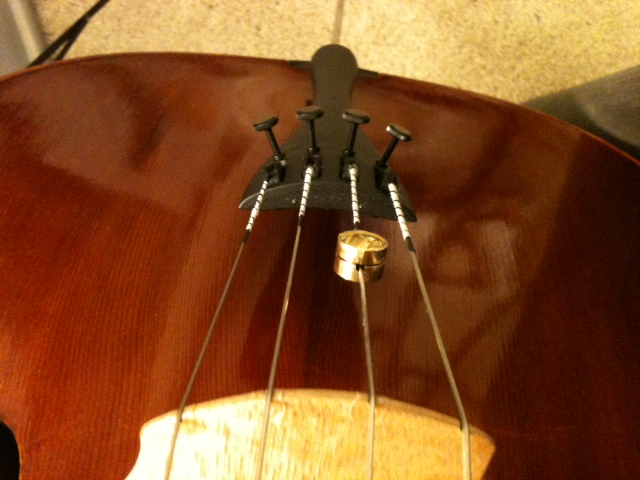
              He asked if my teacher knew how to put on the wolf tone. I said yes, but I had a feeling that he had a different way to put on the eliminator, so I asked him to double check. And he did it completely different, which was actually a pretty cool way...

              How Reed put on the wolf tone eliminator:
              • Find where the wolf is - I thought mine was on E on the D string, but when I got home the wolf was on my f sharp!! So I repositioned it, which is why the picture of the wolf tone eliminator above is farther from the bridge. The picture below is where it is currently (wow, iphone photos rock!)
              • Place the wolf tone eliminator on the string between the bridge and the tailpiece (most commonly on the G string)
              • Bow on the string between the bridge and tailpiece (see below) to find the same note the wolf tone in on. Do this by looking at a tuner and moving the eliminator closer or farther from the bridge. It sounds pretty bad (high pitch squeeling!) bowing in this section, but the tuner will pick up the note (surprisingly!)


              Jeez, its only been two months and I’m already bringing my cello in for adjustments. I wonder if I’ll be like one those paranoid parents who bring their kids in for checkups because of minor colds and scratches! Oh well... my cello is my baby! :)

              Friday, June 3, 2011

              Yo-Yo Ma Bach Suites

              My teacher let me borrow a 2 disc CD of The Cello Suites Yo-Yo Ma Inspired By Bach and the Great Cellists by Margaret Campbell after I requested that during the summer I wanted to learn more about cello history, cellists, etc. and how to improve my intonation.


              Assignment: read the book and listen to the CD for phrasing to familiarize myself with the Bach Suites. From my understanding, phrasing is where one section starts and the other begins. I guess the more familiar I am with important cello pieces, the more I can recognize when something doesn’t sound “right.”

              "The six Bach Suites are considered by many to be the most challenging pieces in the solo repertoire." I'm definitely not at the skill level to play this, but I'm sure listening to this sooner than later will help my musicality and understanding since I wasn't exposed to classical music when I was younger (and didn't like listening to it *gasp*) until I started playing the cello.

              I listened to the CD for a couple of weeks, and basically thought, “Yep… sounds good…its Yo-Yo Ma! Now what?”

              A week later, I was doing my usual YouTubing about.... and found Yo-Yo Ma's Bach Suites and came across other master cellists playing the suites via the recommended viewing list. I had an “ah-ha” moment - that’s what he meant by phrasing!!! …doh!

              As I listened to each master cellist play, I was surprised how the interpretation from each cellist was so different – actually I was more surprised I could tell at all!! Maybe listening to Yo-Yo Ma every day for the last two weeks made it easier for me to distinguish the difference.

              Below are links of cellists playing Bach Suite 1 Prelude:

              I should probably discuss the differences I perceived from each cellist, but this blog is getting too long again! Why can't I keep my blogs nice and short?

              Adam also suggested that I follow along as I listened to the suites, which I have yet to do. Here's a website to download the Bach Suites for cello in PDF for free: http://abel.hive.no/trumpet/bach/cellosuite/

              However, I did the read-along for the Suzuki songs and this has helped me with recognizing how a note is played. This is a no-brainer: we initially learn to read by following along when our parents read to us before bedtime, or in school when we were first taught to read.

              Why didn't I apply this before? It's almost so simple and basic that I almost thought it was too ridicules to try (or maybe I thought I would feel ridicules trying this)! I guess we use this "follow-along" learning method for a reason - because it's a tried and tested method. Although I should probably look up the mechanism that allows this to work...

              I even started singing along with the Suzuki songs "da daaaa da daaa." I'm sure my singing is off key, but still, I can already tell that it's working because I can flip to any of the songs in the Suzuki book or other beginner method books and "sound out" how I think the song is played...albeit off tune.

              TIP OF THE DAY: Read along with the notes as you listen to the piece being played.


              Other cool factoids I came across: 
              I read through the CD cover and learned that Yo-Yo Ma had learned the Bach Suites when he was four years old by learning two measures at a time!! ...hhmmmm…I wonder if I should do this!!!  J

              Some other tidbits from the CD cover: each collaboration lasted for about 2 years with each artist:
              • First Suite: Yo-Yo Ma and the garden designer Julie Moir Messervy & explored themes related to Nature
              • Second Suite : Yo-Yo with director Francois Girard explored daring spaces and perspedctive in the work of Piranesi
              • Third Suite: Mark Morris choreopgraphed a new dance
              • Fourth Suite: Director Adam Egoyan created a film in which music is the link between human characters
              • Fifth Suite: Kabuki actor Tamasaburo Bando explored themes of pathos and transcendence
              • Sixth Suite: ice dancers Jayne Torvill and Christopher Dean skaed a celebratory cosmic dance 
              It was interesting to watch the YouTube videos after reading through the CD jacket - it makes more sense why he used specific images. Actually, I should probably rent the entire DVD instead of watching it on YouTube because its supposed to have more information and a biography...

              Monday, May 30, 2011

              Wolf Tone Eliminator/Suppressor

              I'm doing a bunch of quick posts to catch up with my notes, and will probably update or add to these later as soon as I get caught up with my entries.

              I had a horrible wolf tone on my D string, which my teacher pointed out later when I hit a wolf tone during my recital. Adam explained that every cello has a wolf tone, and the wolf tone is typically found between D and G - usually around F, like mine does. 

              The wolf tone was not present before; however, I read that better instruments and correct finger positions will produce the wolf tone. So on the positive side, my cello is a definite step up from my initial laminate-rented cello and I'm finally getting my fingerings correct! :)

              This is a great article from Strings Weekly on wolf tones: How To Tame Annoying Howling Wolf Tones by Sarah Freiberg.  A paraphrase the article and some additional notes below.

              Another great article on wolf tones by Aitchison Cellos: Wolf Notes


              What is a wolf tone?
              A wolf tone can normally be found on the lower strings of the cello and is a result of the instability between the vibration of the body of the cello and the vibration of the affected string. The air volume and the top, or the air volume and the back tries to cancel each other out. When the sound waves are slightly out of sync, the wolf tone appears - the sound gets louder for a bit and then the waves cancel each other out. There is so much energy when the two notes are out of sync that the top of a sound wave's pitch goes UP and at the bottom it goes DOWN.  The vibration of the affected string has barely begun to sound when it disappears and is repeated again. which leads to an oscillation, howling or out of tune note.

              Well-made cellos have stronger wolf tones:
              Every well made, properly proportioned cello has a wolf tone and the wolf is not the result of a basic structural failure, faulty repair job, or misplaced soundpost. It's just a characteristic of the cello because the process of amplifying the sound of the string through the body of the instrument is imperfect.

              Better sounding instruments tend to have stronger wolf tones because powerful resonances are required for good-sounding cellos, which increase the likelihood of wolf tones.  Also, if your cello is in good adjustment, the wolf can be more pronounced. This is because a cello that is not well adjusted has pitches that are wobbly so a ring is not present when playing and harmonics will be off pitch. When harmonics aren't matched, there is a range of pitches for each note and nothing is focused, so the wolf can hide or make for just general "wolfy" areas.

              It's a good idea to bring your cello in for an adjustment first to ensure the bridge and soundpost are fitting properly, which will allow for better assessment of the wolf problem.

              Wolf on D string:
              If the wolf is noticeably present on the D string and the wolf 'stuttering' on the D string in first position is easily elicited, then the soundpost may not be giving the cello enough support and may need to be repositioned, tightened, or a longer post may need to be made at the point - so bring your cello to a luthier for a checkup. However, setting the soundpost may make a stronger sound, causing a stronger wolf to appear. Finding the optimal balance between maximizing the sound of your cello, but minimizing,taming a wolf is key. Unfortunately, there is no perfect solution.

              Still on my to-do list: bringing my cello to my luthier to check to see if my wolf on D string can be tamed if adjustments are made to the soundpost or bridge of my cello.

              Selecting a surpressor - less is better:
              Don't put on a heavy wolf eliminator if you can get by with something less intrusive because wolf eliminators also act as filters and can dampen the sound of the cello. Since all good cellos have a wolf, any eliminators take away from the voice of the instrument in one way or another to a lesser or greater degree. Less is better, here's why:
              • By completely "eliminating" the wolf, you may be eliminating other resonances as well, i.e. this will remove all supporting overtones that color or enhance the note or related notes.
              • Attaching wolf eliminators/suppressors will directly affect a specific pitch or note which could be the reason some players feel a loss of tone, vibrations or color from their cello.
              The goal is to find the least invasive wolf eliminator to the cello's whole acoustic system while retaining a high degree of success with the cello player.

              Types of surpressors/eliminators:
              1) Single rubber mute - the cheapest and easiest wolf suppressors you can use - you may already have one at your disposal. Since the most bothersome wolf usually hovers around fourth position on the G string, put your mute there (between bridge and the tailpiece).

              2) Wolf suppressors on individual strings - If a mute doesn’t do the trick, there are wolf suppressors that fit on one string—in that same area between the bridge and the tailpiece. The usual on-string suppressor consists of a brass tube encircling a rubber tube, held on the string by a screw. Below are two of the most common wolf suppressors used. There are others, but these two were the ones that were highly rated in forums:
              • Lup-X Eliminator - comes in a 8.4 grams only
              • New Harmony Wolf Eliminator - devised by retired scientist turned cello-builder and cello-innovator David Bice. These are brass wolf suppressors that fit directly on the string without using either rubber or a screw to affix them, and they come in different weights: 5, 7, 9, 11, or 13 grams. A heavier wolf eliminiator gives a punchier sound on the cello, so for a dark-sounding cello, a suppressor with more mass may be needed.

              Placement of the eliminators:
              Finding and placing the wolf eliminator/suppressor in the correct place between the bridge and tailpiece to get rid of the wolf can be complicated. This involves plucking or bowing on the right place between the bridge and the tailpiece to find the correct spot. There are many methods for finding the correct placement.

              Here's a helpful YouTube video explaining one of the methods: Finding and Fixing a Wolf Tone

              1) Mute locations - Match the pitch of the string between the bridge and the mute to the wolf tone, or to a harmonic of the wolf and should get your to the right position. This will usually be about three-quarters of the way towards the bridge.

              2) Suppressor string locations - as with the mute, match the pitch of the string below the bridge to the pitch of the wolf. Sometimes, a wolf suppressor "works better on the C because you allow the G string behind the bridge to enhance or vibrate sympathetically with other notes on the musical scale. Plus, with G strings made smaller in diameter these days, they aren’t able to add mass (along with the suppressor) to help with the suppressing job."


              Other options:
              1) Adding a tuned resonator to the top of the instrument.  The Wolf Resonator comes in three specific ranges (D to E, E flat to F, E to F#) and costs about $52. This is basically a spring-mounted weight that compensates and thus suppresses the distrurbing vibrations. The device can be installed inside or outside the cello with putty.
              2) Add a finger - You can lessen the severity of a wolf tone by placing an available left-hand finger on another string at the pitch of the wolf or an octave of it.

              3) Use your legs - Squeeze the cello with your legs to prevent the cello from vibrating when you bow on the wolf note.

              A wolf tone is unique and individual to each cello and cellist. Since every cello and every setup is different and requires different solutions to remove wolf notes, I recommend exploring the many different solutions and finding one that works for you. There is a lot of information out there, but hopefully I covered all the important items. Below are some helpful forums, which is also where I started my search on this topic.

              Helpful forums regarding wolf tones:
              Forum: http://cellofun.yuku.com/topic/4754
              Forum: http://cellofun.yuku.com/topic/5521
              Forum: http://cellofun.yuku.com/topic/5964
              Forum: http://cellofun.yuku.com/topic/10852/t/Wolf-Tone-device.html
              Forum: http://www.celloheaven.com/viewtopic.php?f=15&t=938


              And the winner is...:
              After my research I settled on the Lup-x Wolf Tone Eliminator for a couple reasons:

              1) I read through a lot of articles and forums and there were a lot of good reviews on Lup-x
              2) I didn't want to go through the hassle of buying different grams through New Harmony and then returning the ones that didn't work. Also, I have very limited knowledge on placement of the eliminators (only what I've read) so I didn't want to spend time moving around 5 different eliminators to try to find the perfect spot for each one, and I already spent a lot of hours researching wolf tones and its eliminators, so this extra step didn't appeal to me. 

              I purchased the Lup-x and decided to bring it to my lesson and have Adam put it on my cello instead. When I handed it over to him he mentioned that he used the same one! Wish I would've known that before researching it so thoroughly, although I did learn a lot about wolfs tones. I guess it was a good decision on my part. I could also add that to my list of reasons to purchase Lup-x - because my teacher uses it! :)
               
              My cello with Lup-x Wolf Eliminator: